
Employee Stock Ownership Plans (ESOPs) for Construction Companies: The Complete Guide
An employee stock ownership plan (ESOP) lets a construction owner sell the company to the people who built it, at fair market value, without handing it to a competitor or a private equity fund. This guide walks through how that works in a bonded, project-based business: who is a candidate, how the deal is planned, structured, and financed, what it does to your bonding program, and what life looks like after the close.
It is written for owners, CFOs, and leadership teams of general contractors, heavy civil firms, and specialty trades. The voices in it are contractors and advisors who have done it, from guests on the Construction ESOP Collective podcast.
What an ESOP is, and why it fits construction
An ESOP is a qualified retirement plan, governed by ERISA and overseen by the Department of Labor and the IRS, that buys and holds company stock for employees. A trust purchases shares from the owner. Employees receive shares in their accounts over time, at no cost to them. When they retire or leave, the company buys those shares back at the current appraised value.
For the seller, it is a liquidity event at an independently appraised price. For employees, it is a second retirement account on top of the 401(k). For the company, it can mean a very large tax advantage: an S corporation that is 100% owned by an ESOP generally pays no federal income tax on its earnings.
Construction is one of the most common industries for employee ownership, and the reasons are practical:
-
The value is the people. A contractor's worth sits in its superintendents, project managers, estimators, and field leaders. A sale that scatters them destroys what the buyer paid for.
-
Outside buyers are scarce below a certain size. Many solid contractors are too small or too cyclical for private equity and too large for a key employee to buy outright.
-
Owners care about legacy. Most founders want the name to stay on the trucks.
Alan Starks, who leads the surety practice at Christensen Group, hears it in nearly every exit conversation:
"They don't want the dump truck full of cash and to disappear off in the sunset. These entrepreneurs have put their blood, sweat, and tears into it. When we start having these exit discussions, we're talking about legacy before we get to the financial piece." Alan Starks, Christensen Group (Episode 4)
David Jaeger of Legacy Utility Group fielded private equity offers for years before choosing an ESOP:
"It just never felt right. They already have a me. They already have a COO or a safety person or a controller. It felt like they were going to come in, buy my market, and maybe keep ten percent of us." David Jaeger, Legacy Utility Group (Episode 3)
For a side-by-side look at the two paths, read ESOP vs. Private Equity for Construction Succession.
Benefits of an ESOP for a construction company
An ESOP gives a construction owner a fair market value exit without selling to a competitor or a private equity fund. It gives the company a lasting tax advantage, gives employees a retirement benefit they do not pay for, and keeps in place the leadership team your surety and bank are underwriting.
-
For the seller. Liquidity at an independently appraised price, the option to sell in stages (a minority stake, a majority, or 100%), and, for C corporation sellers, the potential to defer capital gains under Section 1042. Most sellers stay involved for several years, so they can protect the name on the trucks while the next generation takes over.
-
For the company. Contributions used to repay the ESOP loan are tax deductible within IRS limits, and an S corporation that is 100% owned by an ESOP generally pays no federal income tax on its earnings. That cash funds the buyout: for a contractor earning $2 million a year, Starks estimates roughly $800,000 a year in free cash flow from not paying corporate income tax.
-
For employees. A second retirement account on top of the 401(k), funded by the company and revalued every year. Employees do not buy their shares.
-
For the bonding and insurance program. Continuity. The people who built the company keep running it and now own it, so the leaders your surety, bank, and trustee are counting on are more likely to stay than after a private equity sale. Employee owners also have a direct reason to control losses, because every claim flows through earnings into the share price.
-
For recruiting and retention. Ownership gives superintendents, project managers, and foremen a reason to stay and a financial stake in safety, schedule, and quality. Legacy Utility Group uses plan eligibility as a career incentive for union foremen who want to move into management.
The benefits come with trade-offs: acquisition debt, permanent administration costs, and a balance sheet your surety will read closely. Those are covered under the most common implementation challenges, later in this guide.
Is your construction company a candidate for an ESOP?
Most contractors who succeed with an ESOP share four traits: steady cash flow, enough scale to absorb the cost, a management team with runway, and an owner who wants to stay involved through the transition.
Consistent cash flow. The company buys itself with its own future earnings, so lumpy profits are the biggest red flag. Starks puts it plainly:
"You really want a level cash flow for the ESOP to work. If one year you hit two home runs and make a pile of cash, and the next year you have a couple of clunkers and lose money, maybe they're just not a perfect fit." Alan Starks, Christensen Group
Enough scale. An ESOP adds permanent costs: trustee, annual valuation, plan administration, legal. Starks suggests a working threshold of roughly $2 million a year in free cash flow, where the tax savings alone can cover those costs and still help pay down the debt.
A management team that outlasts the seller. The surety, the bank, and the trustee will all ask who runs the company in ten years. If every key leader is 63, fix that first. Bill Duguay, former CEO of J.D. Abrams, frames it as the real test:
"Have they built a business that can run without them? Many businesses rely on the founder: their knowledge, their network, their entry into different rooms. The ultimate gift is not just the ESOP. It is that the ESOP can thrive without them." Bill Duguay, former CEO, J.D. Abrams (Episode 1)
An owner who is not in a hurry to vanish. Sellers usually carry a note and stay engaged for several years. Jaeger's advice:
"You shouldn't do it if you just want to ride off into the sunset. If you're done and you don't want to help out or be on the board, it's probably not a fit for you." David Jaeger, Legacy Utility Group
Union contractors are candidates too. Collectively bargained employees are often excluded from the plan because they already have union retirement benefits, which means the ESOP covers office, management, and non-union field staff. Jaeger's team uses that line as a career incentive for foremen who want to move into management.
Construction ESOP planning: start with a feasibility study
Planning a construction ESOP starts with a feasibility study, a low-cost analysis that tells you whether the company can afford to buy itself before you commit to the transaction.
A good feasibility study answers five questions:
-
What is the company likely worth? A preliminary valuation range, not the final appraisal.
-
How much debt can it carry? Projected cash flow against bank debt and seller note payments, under good years and bad.
-
What happens to the balance sheet? Pro forma working capital, equity, and debt-to-worth on the day after closing. For a bonded contractor, this is the page your surety will read first.
-
What do the seller's after-tax proceeds look like compared with a third-party sale?
-
What will the repurchase obligation cost as employees retire over the next 10 to 20 years?
Many owners assume they will not qualify. Jaeger did:
"I kicked the tires on a feasibility study and thought, I'm probably not going to qualify, probably not big enough. I got a call back and they said, yeah, you qualify. What do you want to do?" David Jaeger, Legacy Utility Group
Plan the board at the same time. Duguay's strongest advice is about governance, and he wants it moved earlier than most owners expect:
"If you're thinking about a transaction, be thinking about your board. Who's on it? Many times it's your banker, your lawyer, your golf buddy. They're not challenging the CEO. Start thinking about how to professionalize it and get the skills you need to help you through this." Bill Duguay, former CEO, J.D. Abrams
Plan early. Starks tells clients who want their risk off the table in five to seven years to start the conversation now. Ownership transitions that begin with a 90-day deadline leave advisors almost no room to steer.
How a construction ESOP transaction is structured
In a leveraged ESOP transaction, the company creates an ESOP trust, the trust buys the owner's shares at a price an independent trustee approves, and the company funds that purchase with a mix of bank debt and a note held by the seller.
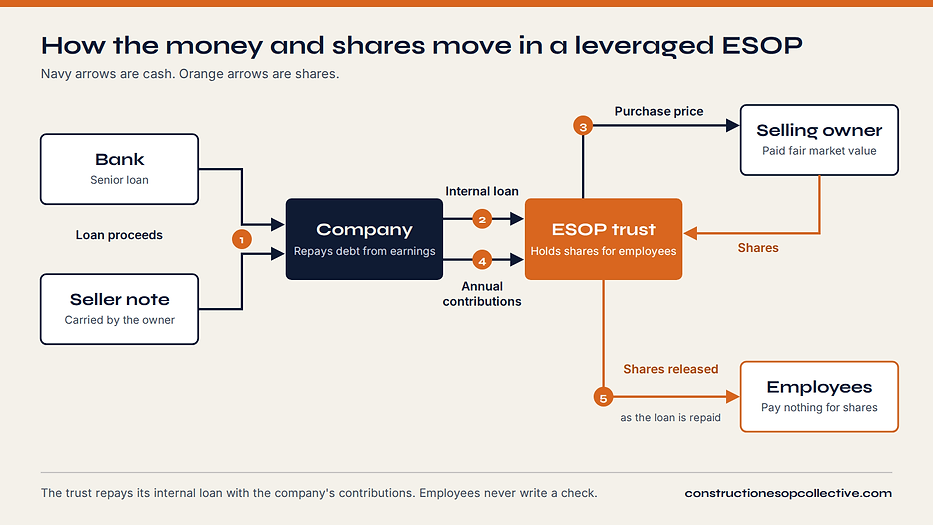
How the money and shares move:
-
The company borrows from a bank and takes on a note from the seller.
-
The company lends those funds to the ESOP trust (the internal loan).
-
The trust pays the purchase price to the selling owner and receives the shares.
-
Each year the company makes contributions to the trust, which the trust uses to repay the internal loan.
-
As the loan is repaid, shares are released into employee accounts.
The company makes tax-deductible contributions to the trust each year. The trust uses them to repay its internal loan, and shares are released into employee accounts as that loan is paid down.
The decisions that shape the deal
-
How much to sell. Common choices: Minority stake, majority, or 100%. What drives it in construction: 100% S corporation ESOPs get the full income tax benefit. Partial sales keep family control and leave room for a second stage.
-
Entity type. Common choices: S corporation or C corporation. What drives it in construction: C corporation sellers may defer capital gains under Section 1042. S corporation ESOPs shelter ongoing earnings.
-
Seller financing. Common choices: Seller note, often with warrants. What drives it in construction: Note terms and subordination directly affect how the surety reads your balance sheet.
-
Who participates. Common choices: All eligible employees, often excluding collectively bargained staff. What drives it in construction: Union benefit structures and plan testing rules.
-
Management incentives. Common choices: Stock appreciation rights (SARs) or similar. What drives it in construction: Retaining the next generation of leaders the surety and bank are underwriting.
Jaeger's family sold 49% in the first stage, with a plan to pay down the note and sell more within 10 to 12 years:
"It was an opportunity for my dad to sunset, create liquidity, and still have a few chips on the table, because we didn't fully 100% ESOP. We did 49%. Everybody says your business is family. We were actually able to put shares in people's hands." David Jaeger, Legacy Utility Group
J.D. Abrams went straight to 100%. HB McClure, the mechanical contractor that became HB Global, also went 100% and then used the structure as an acquisition platform. Bob Whalen describes the result:
"We bought a business for a little over five million dollars that's turned into an equity value of three hundred million. And that's all for the benefit of the employees. It's not for some financier in some big metropolitan area. It's right in our town." Bob Whalen, CEO, HB Global (Episode 2)
How a construction ESOP gets financed
Most construction ESOPs are financed with two layers: senior debt from a bank and a subordinated note carried by the seller. Employees do not write a check.
Senior bank debt typically covers part of the price, sized to what the company's cash flow and collateral support. Contractors already carrying equipment debt have less room here, which is why heavy civil deals often lean harder on the seller note. A bank that knows ESOPs matters. Jaeger credits his with making a fast-moving first year workable:
"The big thing we have right now is a really good banking relationship. They're familiar with ESOPs, and they've been great in helping us understand." David Jaeger, Legacy Utility Group
The seller note covers the balance. It is paid over a period of years, usually at a rate that reflects its subordinated position, and sometimes with warrants that give the seller upside if the company grows. In construction, the seller note does a second job: when it is formally subordinated to the surety, underwriters can treat it like equity.
Debt service usually ramps. Duguay notes that many deals are built with an interest-only period before principal payments begin, which gives the company time to adjust.
The tax savings fund the payoff. This is the engine. Starks walks through the math for a contractor earning $2 million a year:
"We're probably talking about $800,000 that we're creating in free cash flow by not paying corporate taxes. Now we've got enough mass from a cash standpoint to pay the attorneys, the TPA costs, the valuation, and still move forward." Alan Starks, Christensen Group
Sellers see a tax benefit as well. Jaeger's father looked at it this way:
"The tax component was a large part of getting the ESOP deal done. The way my dad viewed it, if they gave him five million dollars cash, that was essentially ten million dollars in value." David Jaeger, Legacy Utility Group
Expect a three-phase life cycle. Starks describes it as three to five years focused on paying down acquisition debt, then a five-to-twelve-year stretch where free cash flow builds and the ESOP "really starts kicking," then a mature phase where repurchase obligations become the main call on cash.

How a construction company is valued for an ESOP
An ESOP can pay no more than fair market value, and an independent trustee, advised by an independent appraiser, decides what that is. The seller does not set the price.
Appraisers typically weigh an income approach (discounted future cash flow) and a market approach (what comparable companies trade for). In construction, a handful of factors move the number more than anything else:
-
Earnings consistency. Five steady years are worth more than two great years and three poor ones.
-
Backlog quality and margin fade. Appraisers look at how your booked work has historically performed against estimate.
-
Customer and project concentration. One owner or one mega-project carrying the revenue is a discount.
-
Management depth. The same succession question your surety asks.
-
Working capital needs. Cash that must stay in the business to support bonding is not excess cash.
The stock is revalued every year after the transaction, and that annual number becomes the share price employees see on their statements. It will not move in a straight line. Whalen is direct with his 2,000 employee owners about that:
"Our stock will drop again someday. This is not a straight line of success. Employees want all the good things about equity, but there's other stuff that goes with it. We take that responsibility very seriously in trying to make them better business people." Bob Whalen, CEO, HB Global
Duguay adds that leadership teams need to learn how the valuation works, because after the close, capital decisions on debt, equipment, and acquisitions all show up in the share price.
The advisor team you need
An ESOP transaction takes six to eight outside parties, and in construction the surety broker belongs in the room from the first meeting, not the last.
-
ESOP advisor or investment banker: Runs feasibility, structures the deal, arranges financing
-
ESOP counsel (company side): Drafts plan documents and transaction agreements
-
Independent trustee: Represents the employees as buyer and negotiates price and terms
-
Trustee's appraiser and counsel: Independent valuation and legal review for the trust
-
Lender: Senior debt, ideally with ESOP experience
-
CPA firm: Pro formas, tax planning, post-close accounting
-
Third-party administrator (TPA): Runs the plan: allocations, statements, testing
-
Surety broker and insurance advisor: Keeps the bonding program intact and re-underwrites risk through the change
Duguay calls it the Super Bowl of transactions:
"There's a lot of fingers in this pie. Every one of them is important, so pick your team well. It's okay to interview several to really get the team right." Bill Duguay, former CEO, J.D. Abrams
Starks's rule is to get everyone talking to each other early:
"Get your surety agent, the lawyers, your ESOP people, your tax guy, your banker all in a room. We're all going to have different angles that are important to us. Let's make sure everything's on the table up front, before anything's put in writing." Alan Starks, Christensen Group
Duguay flags one role that is usually missing: someone who prepares the CEO and leadership team for what it means to operate as an ESOP once the deal team goes home.
How long a construction ESOP takes
Plan on 8 to 16 months from a serious first conversation to closing. Jaeger's deal took about 15 months. Complex conversions can run longer: the J.D. Abrams conversion took roughly a year and a half of behind-the-scenes work.

-
Education and goal setting. Typical duration: 1 to 3 months. What happens: Owner goals, legacy vs. price, early talk with surety broker
-
Feasibility study. Typical duration: 1 to 2 months. What happens: Preliminary value, debt capacity, pro forma balance sheet
-
Team selection and design. Typical duration: 2 to 3 months. What happens: Advisors, trustee, plan design, board planning
-
Valuation, negotiation, financing. Typical duration: 3 to 6 months. What happens: Trustee due diligence, price and terms, lender commitments, surety sign-off
-
Closing and rollout. Typical duration: 1 to 2 months. What happens: Documents, funding, employee announcement
The longer clock is the one that starts after closing. Expect three to five years of focused debt paydown before the company has real financial flexibility again, and hold off on acquisitions until that first stretch is behind you.
Common challenges in construction ESOP implementation
The biggest challenges in a construction ESOP are financial and organizational. The transaction pushes book equity negative and tests your bonding program, the company carries acquisition debt for years, the plan adds permanent costs, and employees do not start thinking like owners just because they hold shares. Each one is manageable when it is planned for before closing.
-
Protecting bonding capacity. A leveraged ESOP flips the balance sheet to negative equity on closing day. Without a subordinated seller note and day-one pro formas, the surety may tighten capacity right when the company needs it. The next section covers how to keep the program intact.
-
Carrying debt in a cyclical business. The company buys itself with future earnings, so a down year or a backlog gap can land while acquisition debt is still being repaid. Stress test the plan for a bad year before you close.
-
Permanent costs. Trustee, annual valuation, plan administration, and legal fees continue for the life of the plan. Starks's working threshold of roughly $2 million a year in free cash flow is about making those costs affordable.
-
Leadership depth. Lenders, the trustee, and the surety all underwrite the next leadership team. If the seller still holds every key relationship with customers, the bank, and the surety, start transferring those relationships first.
-
Share price swings. The stock is revalued every year and will not move in a straight line. Leaders have to understand the valuation and be ready to explain a down year to employee owners.
-
The repurchase obligation. Buying back shares from retiring and departing employees becomes the main call on cash as the plan matures, and it needs a study and a funding plan years before it peaks.
-
Culture and communication. Most announcements are met with silence. The performance lift comes from years of education and communication, not from the transaction itself.
-
Governance. A board made up of the owner's banker, lawyer, and friends rarely challenges the CEO. An employee-owned company needs independent directors and clear lines between the trustee, the board, and management.
What an ESOP does to your bonding, surety, and insurance program
A leveraged ESOP pushes book equity negative on closing day, and surety underwrites the balance sheet. That is the single biggest construction-specific risk in the transaction, and it is manageable if the surety is involved early.
Why the balance sheet flips
The company borrows to buy shares at a multiple of book value. The debt lands on the balance sheet. The offsetting entry reduces equity. Starks explains what the surety sees and how it gets solved:
"By definition, when we do an ESOP transaction, that balance sheet's going to flip and you're going to have negative equity. If the seller is willing to leave some chips on the table in the form of that note, saying they're not going to take that money out unless the surety is okay with it, then the surety is going to add that back to the balance sheet and create positive equity again." Alan Starks, Christensen Group
The three numbers your surety will watch

-
Working capital. Rule of thumb from Starks: About 5% of the program, or an aggregate of roughly 20 times working capital. Why it matters after an ESOP: The one number you cannot manufacture. Protect it in the deal design.
-
Equity. Rule of thumb from Starks: Positive after adding back the subordinated seller note. Why it matters after an ESOP: Subordination language is what makes the add-back possible.
-
Debt to worth. Rule of thumb from Starks: Stay at or under roughly 4 to 5 to 1, or have a fast plan to get back there. Why it matters after an ESOP: Equipment-heavy civil contractors start closer to the limit.
Starks wants at least two of the three healthy enough to carry the one the transaction weakens.
What sellers need to hear early
The bonding program is part of what the trust is paying for. A heavily bonded contractor with no surety support is worth far less. Starks tells sellers to expect to stay involved through note subordination and possibly a limited personal indemnity for a period:
"That risk they're still taking is getting them significant value in the sale price, because they're allowing that contractor to still have the existing surety program to create the profits and the cash flow needed to pay off the debt." Alan Starks, Christensen Group
Duguay adds a drafting point: sureties focus on who has priority of payment. They want vendors, subcontractors, and bonded obligations paid ahead of the ESOP trust, so that language should be negotiated alongside the transaction documents, in lockstep with your ESOP counsel.
How to keep the program intact
Ralph Dumke learned the order the hard way. His surety shut down Waterline Industries' first ESOP attempt almost 20 years ago. A decade later, a different surety brought an ESOP attorney to his office, and the deal went through. His advice:
"If somebody's going to do an ESOP, before you do anything, especially if you're in construction, and especially if it's bonded construction, the first thing you do is have the conversation with the bonding company. The next place I would go is the bank." Ralph Dumke, Founder and CEO, Waterline Industries (Episode 7)
-
Tell your broker and surety before you engage the deal team, not after closing. Sureties do not like surprises.
-
Deliver day-one pro formas: post-close balance sheet, debt service schedule, and cash flow forecast.
-
Stress test it. Show the plan for a bad year, a reduced bank line, or a slow seasonal start, including whether the seller will backstop short-term liquidity.
-
Model the repurchase obligation and share the analytics.
-
Stay with the surety that knows you if you can. A 20- or 30-year relationship buys capacity when the balance sheet looks its weakest.
There is a positive side of the underwriting story too. The people who made the company successful are still running it, and they now own it. As Starks puts it, there is a much better chance they stick around than after a private equity sale.
Go deeper: Surety Bonding and the ESOP Conversion and Episode 4 with Alan Starks.
Insurance and risk management
Ownership changes what you need from your insurance program, and employee ownership can improve how it performs.
-
New exposures. ESOP fiduciaries need fiduciary liability coverage, and directors and officers limits should be revisited once there is an independent trustee and a more formal board.
-
Key person and seller note protection. Lenders and sellers often want life and disability coverage on the leaders the deal depends on.
-
Safety becomes a share price issue. Every loss flows through earnings into the annual valuation. Duguay argues safety metrics belong on the company scoreboard, not in a binder: "When it shows up on the leaderboard, it is who we are, what we do, and not just something we track."
-
Group captives fit the ownership mindset. Employee owners who share in the results have a direct reason to control losses, which is the behavior captives reward.
Repurchase obligation: the long-term cost to plan for
Repurchase obligation is the company's legal duty to buy back shares from employees who retire, leave, or diversify. It is small in the early years and becomes the main call on cash once the ESOP matures.
Two things drive it: a rising share price and an aging workforce. Success makes it bigger. After ten years in the plan, participants who reach age 55 can also begin diversifying part of their accounts, which creates cash demand before anyone retires.
Ben Nichols leads Harkins Builders, a 100% employee-owned general contractor with decades of ESOP history. His approach is steady funding:
"You have a good idea of when your people are going to start diversifying or taking distributions once they retire. You need to plan for it, and make sure you're constantly feeding the ESOP with cash so you can meet those repurchase obligations." Ben Nichols, President and CEO, Harkins Builders (Episode 6)
Starks warns equipment-heavy contractors about what he calls yellow fever: spending the free cash flow that appears once the acquisition debt is paid instead of building the reserve.
Practical steps:
-
Commission a repurchase obligation study within the first few years and update it regularly. Bobby Sigmon's team at Sessa Sheet Metal did their first one a few years into the plan.
-
Share the study with your surety and bank. It shows you are managing the liability, not ignoring it.
-
Decide on a funding method early: cash reserves in the plan, a sinking fund, or recycling shares inside the trust.
Read more: The ESOP Repurchase Obligation as a Growth Advantage.
Life after the close: why culture matters in a construction ESOP
Culture matters in a construction ESOP because the ownership structure only pays off when employees act like owners. The tax savings repay the debt. What grows the share price after that is daily decisions in the field and the office: fewer losses, better job margins, and people who stay.
The transaction changes who owns the stock. It does not change how people work. That part is a multi-year leadership job, and contractors who skip it get the debt without the performance lift.
Expect a quiet first reaction. Jaeger was warned that most announcements are met with crickets, and his was. Employees want to know what it costs them (nothing), whether the company is okay, and whether the owner is leaving.
Repeat the message far more than feels necessary. Duguay's rule:
"Adult learners need to be told at least seven times before they hear it for the first time. The first couple of years, before you get a statement, it's like funny money. We're trying to bring tangible value to something that feels intangible." Bill Duguay, former CEO, J.D. Abrams
Build simple channels. Legacy Utility Group set up a dedicated ESOP email that goes straight to the CEO, open calendar slots for one-on-one questions, a monthly note tying daily decisions like fuel savings to share price, and ESOP, culture, and safety committees.
Culture comes first. Sigmon started at Sessa Sheet Metal as an apprentice and is now its president:
"Culture is what builds the ESOP, not the ESOP builds the culture. If people aren't thinking about how the details of their daily tasks affect the ESOP, it's tough to stay profitable." Bobby Sigmon, President, Sessa Sheet Metal Contractors (Episode 5)
Remember what it is for. Harkins Builders became employee owned because its late owner, Blase Cooke, wanted it that way. Nichols retells the meeting:
"He said, I want to turn this into an employee-owned company, and the reason is I want every single person sitting in this room to not have to work again in retirement, and to be millionaires when you retire after a full career at Harkins Builders. It's come true over and over again." Ben Nichols, President and CEO, Harkins Builders
Governance in a construction ESOP: the trustee, the board, and management
In an ESOP-owned construction company, employees own shares through the trust, but they do not run the company. The ESOP trustee votes the shares held by the trust and typically elects the board of directors, the board hires and oversees the CEO, and management runs the business day to day. Good governance keeps those roles separate and gives the board enough independence to challenge management.
-
ESOP trustee. A fiduciary who acts for plan participants. An independent trustee usually represents the trust in the transaction. Afterward, some companies keep an outside trustee and others appoint an internal trustee or committee with outside support.
-
Board of directors. Sets strategy, approves major capital decisions, and holds the CEO accountable. This is where most contractors need the biggest upgrade.
-
Management. Runs estimating, operations, project delivery, and safety, the same as before the sale.
-
Employee owners. Beneficial owners with annual account statements, not managers. In a privately held ESOP company, participants generally vote their shares directly only on major corporate events such as a merger, a sale of substantially all assets, or a liquidation.
-
ESOP and culture committees. Employee groups that lead education and communication. They are valuable, but they are not a governance body.
Professionalize the board. Add independent directors with skills the next chapter needs: debt paydown first, then growth and acquisitions. Legacy Utility Group committed to adding a fully independent director within two years of closing.
Expect your surety and bank to look at governance too. A board with independent directors, a regular financial review, and a written succession plan answers the question every underwriter asks: who runs this company in ten years?
Read more: The ESOP Transition: What the First 1 to 3 Years Look Like and It Won't Run By Itself.
Subscribe to Built to Own and get new episodes and guides by email. The signup form is at the bottom of this page.
Construction ESOP FAQ
How do construction ESOPs work?
The company sets up an ESOP trust that buys some or all of the owner's stock at an independently appraised price. The purchase is funded with bank debt and a seller note, which the company repays from future earnings. Employees receive shares in retirement accounts at no cost and are paid out when they retire or leave.
What are the benefits of an ESOP for a construction company?
The owner gets a fair market value exit without selling to a competitor or private equity, and C corporation sellers may defer capital gains under Section 1042. The company gets tax-deductible loan repayments, and a 100% ESOP-owned S corporation generally pays no federal income tax. Employees get a company-funded retirement benefit, and the surety and bank keep the leadership team they underwrite.
What are the biggest challenges in implementing a construction ESOP?
Protecting bonding capacity when the balance sheet flips to negative equity, carrying acquisition debt through construction cycles, covering ongoing trustee, valuation, and administration costs, funding the repurchase obligation, and getting employees to think like owners. Most of these are solved by planning early with the surety, the bank, and ESOP advisors.
How do you finance a construction ESOP?
Most deals combine a senior bank loan with a subordinated seller note. The company repays both from cash flow, helped by the tax savings an ESOP creates. In a bonded contractor, the seller note is usually subordinated to the surety so underwriters can count it toward equity.
Can a bonded contractor do an ESOP without losing bonding capacity?
Yes, with early planning. The transaction creates negative book equity, so the surety needs day-one pro formas, a subordinated seller note, strong working capital, and a debt paydown plan. Contractors who bring their surety in before the deal team keep their programs far more often than those who announce it after closing.
How big does a construction company need to be for an ESOP?
There is no legal minimum, but the ongoing costs mean it works best for companies with roughly $2 million or more in annual free cash flow and at least a few dozen employees. Consistent earnings matter more than revenue size.
How long does a construction ESOP transaction take?
Typically 8 to 16 months from the first serious conversation to closing, including a feasibility study, valuation, trustee negotiation, financing, and surety sign-off.
Do employees pay for their shares?
No. Shares are allocated to employee accounts as a company-funded retirement benefit, in addition to any 401(k).
Does the owner have to sell 100% or leave right away?
No. Owners can sell a minority or majority stake and sell more later. Most stay on for several years as CEO, board member, or advisor, and most carry a seller note.
Can union contractors have an ESOP?
Yes. Collectively bargained employees are commonly excluded from the plan because they already receive union retirement benefits, while office, management, and non-union field employees participate.
What is the difference between selling to an ESOP and selling to private equity?
Private equity often pays more cash at closing but usually brings new leadership, a resale within several years, and an uncertain future for the name and the team. An ESOP pays fair market value over time, offers significant tax advantages, and keeps ownership, leadership, and legacy with the people already running the company.
What risks should a project owner consider when hiring an employee-owned contractor?
Ask the same questions you would ask any contractor, plus two: how far along the company is in paying down its ESOP debt, and whether its surety program is fully in place. A mature employee-owned contractor typically offers lower turnover, stable leadership, and crews with a financial stake in safety, schedule, and quality.
What is a repurchase obligation?
It is the company's obligation to buy back shares from departing and retiring employees at current appraised value. It grows as the share price rises and the workforce ages, so ESOP companies fund it on a schedule rather than waiting for the bills.
Why is culture important in a construction ESOP?
An ESOP changes who owns the stock, not how people work. The tax savings repay the debt, but share price growth comes from employees making owner-level decisions on safety, schedule, and cost. Contractors that invest in years of communication and education see the performance lift. Those that skip it carry the debt without it.
Who governs an ESOP-owned construction company?
The ESOP trustee votes the trust's shares and typically elects the board of directors. The board sets strategy and oversees the CEO, and management runs daily operations. Employees are beneficial owners who generally vote directly only on major events such as a merger or a sale of substantially all assets.